You just delivered a two-day workshop. Heads were nodding, the energy was high, and the evaluations said "This is so helpful." Then Monday arrives, and your participants remember approximately nothing.
The good news: it's not really your fault. The bad news: you still have to fix it.
How do you make training stick? Make training stick by designing for retention, not just delivery. Space content over time, have participants retrieve and teach what they learned instead of passively reviewing it, give them reinforcement tools they can choose, and require them to apply one thing within 24 hours. In short: design the reinforcement before you design the content.
In the Creative Training Techniques podcast episode "Why People Can't Remember Your Training," Becky Pike Pluth, CEO of The Bob Pike Group, broke down why people forget training and what trainers can do about it. This article expands on that episode with five Participant-Centered strategies you can use in your very next session, whether it's Instructor-Led, virtual, or blended.
The forgetting curve shows how quickly people lose new information when nothing is done to reinforce it. German psychologist Hermann Ebbinghaus first mapped it in the 1880s, and researchers successfully replicated his results in 2015, so trainers can still take it to the bank.
The pattern is steep and fast. Applied to workplace learning, the commonly cited estimate is that people forget about 70% of new information within 24 hours and up to 90% within a week.
Picture it this way. You deliver a killer workshop on Friday. Everyone is engaged, nodding, celebrating. By the following Friday, it's as if the session never happened.
Most trainers have heard of the forgetting curve. Far fewer design for it. Be honest: if you surveyed your last workshop's participants today, how much would they remember?
Most training is designed for the event, not for the days after it. Common culprits include:
The fix isn't a better slide deck. It's a Participant-Centered design that keeps learners actively using the content long after they leave the room.
Each of these strategies shifts the work of learning from the trainer to the participant. That's the heart of Participant-Centered Learning, and it's why it outperforms the lecture-and-pray approach.
Don't dump everything into one session and hope it sticks. Break your content into chunks and deliver them over time, so each session reinforces the last and sets up the next.
Becky has redesigned many programs this way. One leadership program originally ran as two full days. When the same content was spread over four weeks, retention improved dramatically. Same content, better results.
This is why The Bob Pike Group's online classes run three hours a day over three days instead of one long fire-hose day. Our Instructional Design Workshop meets for two days, breaks for a week, then meets for two more. Participants apply what they learned, then come back for help and feedback.
"I walked out of the first day realizing how much I had already gained. Every day further cemented that feeling."
— Train-the-Trainer Boot Camp participant, Okinawa USMC
That cementing is spacing at work. Each day built on the one before.
Try this: Take your next full-day session and split it into two or three shorter sessions a few days apart, with a small assignment in between.
Go deeper: Spacing matters inside a session, too. Learn how the 90/20/8 rule keeps content in 20-minute segments and involves learners every eight minutes.
Passive review, like rereading notes or rewatching a recording, barely dents the forgetting curve. Active retrieval, like quizzing, practicing, or explaining, is what cements learning. Pulling information out of memory strengthens it in ways that looking at it again never will.
Retrieval takes effort, and that's the point. Resist the urge to rescue learners when they struggle to recall.
The 12-second rule: In our recent podcast episode "Shut Up and Coach," Becky noted that the brain needs about 12 seconds to form a response to a real question, yet most of us jump in after two. Ask a recall question, then silently count to 12. That silence is where retrieval happens.
Try this: Replace your end-of-module recap slide with a 60-second challenge: participants list everything they remember, then compare with a partner.
Go deeper: Quizzing only builds retention when questions require real recall. See 6 Tips for Writing Better Knowledge-Based Test Questions. For skills, practice is retrieval too: Nobody Wants to Role-Play: How to Make Practice Work in Training.
In virtual sessions, try a chat waterfall: everyone types an answer, waits, then hits Enter on "Go!" Every participant retrieves, and no one copies.
Polls and quick checks for understanding do double duty: participants retrieve, and you see who's got it. Learn how in Stop Flying Blind: How to Use Real-Time Feedback to Adjust Training Mid-Session, or practice these techniques in our Interactive Virtual Trainer Workshop.
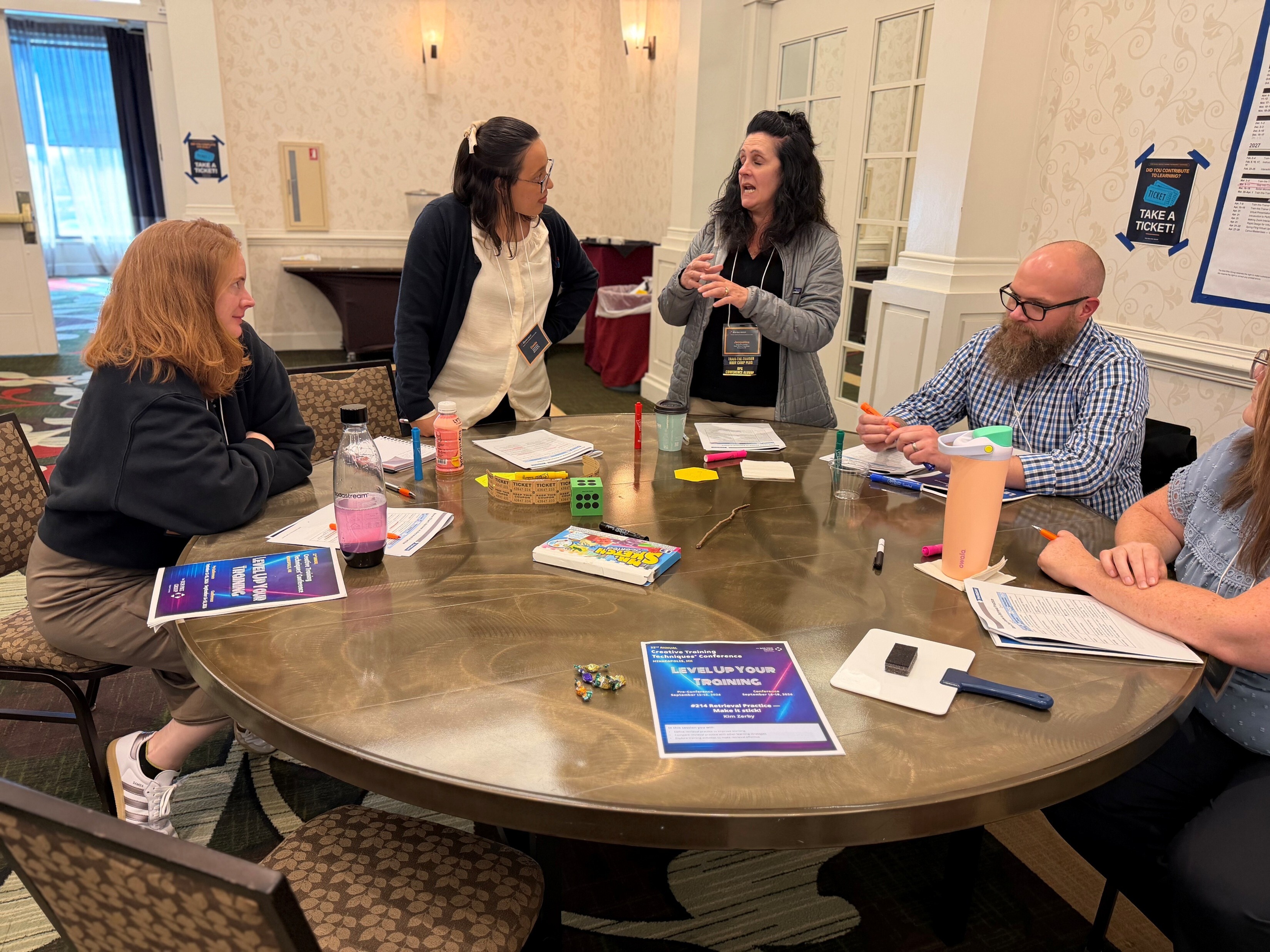
Teaching is one of the most powerful forms of retrieval. To explain something, you have to organize it, recall it, and put it in your own words.
Becky now ends every session with one instruction: "Teach what you just learned to someone who wasn't here today."
"One of the most interactive and informative trainings I have attended."
— Participant, Dairy Farmers of America, Interactive Virtual Trainer workshop
This participant said the takeaways truly stuck. That's the difference between hearing information and using it.
Try this: Close with a "teach-back" pair activity. Each person has two minutes to teach their partner the one idea they'll use first.
Reinforcement works best when participants own it. Give them a menu of ways to revisit the content between sessions, and let them pick what fits how they learn.
AI tools make this easier than ever. Becky recommends NotebookLM: load your notes and workbook content, then ask it to create flashcards or a short video overview. In minutes, you have reinforcement materials participants can use between today's session and next week's.
This works for trainers, too. As a designer of training, you can use the same tools to build reinforcement assets for your audience.
Try this: Offer three reinforcement options after your next session, such as flashcards, a short summary video, and a practice scenario. Ask participants which one they'll use.
Go deeper: For more ways to use AI in your design and delivery, read AI for Trainers: How AI Tools Can Assist With Your Trainings and Professional Development.
Whatever participants learn, they need to use it within 24 hours. Not think about it. Use it.
End every session with one question: "What will you do tomorrow that uses what you learned today?" Then follow up. A simple check-in like "You said you'd have a feedback conversation with Tom. How did it go?" creates accountability and fights forgetting.
The action doesn't have to be work-related to work. In a recent two-day AI class, Becky asked participants to go home after day one and use AI for something personal, like planning where to plant carrots in the garden. Trying it on their own terms produced an aha moment a work assignment wouldn't have, and led to far greater retention and use after the class.
Try this: Have each participant write their 24-hour action on a card or in the chat. Send a follow-up message the next day asking how it went.
Free guide
Make Your Training Fun & Memorable
A strong theme gives participants a hook to hang new learning on, so it's easier to recall long after the session ends. Our free guide covers 9 benefits of training themes, 3 myths and truths, and 5 tips for creating themes your learners will remember.
Here's the mindset shift: plan what happens after training before you plan the training itself. Before you build a single activity, answer these questions:
For every activity you plan, spend equal time planning how participants will use it in different ways afterward. Great training that's forgotten isn't great training. It's entertainment. And you're not in the entertainment business.
This is what decades of Participant-Centered design have taught us at The Bob Pike Group. When participants do the work of learning during the session and after it, the learning lasts. It's also why Instructor-Led Training doesn't have to mean lecture-led. The trainer stays in charge; the participants do the remembering.
The results show up on the job. After Intermedia redesigned its Sales Kickoff with a Participant-Centered Approach, knowledge application rose 30% (read the Intermedia case study). At Johnson & Johnson MedTech, a Participant-Centered Masters Sales Program drove $812K in closed revenue (read the J&J MedTech case study).
Military educators are seeing the same results. At the 7th Annual Military Scholarship of Teaching and Learning (MSOTL) Forum, hosted by Marine Corps University (Dec. 9–10, 2026), our own Sara Davis presents "Participant-Centered by Design," sharing how brain-based, Participant-Centered design produces measurable gains in retention, performance, and institutional efficiency. Her session draws on programs we co-created with the Marine Corps Center for Learning and Faculty Development and the Air National Guard (read the Air National Guard case study).
Want the full framework? Start with How to Design Instructor-Led, Participant-Centered Training: 6 Key Components. It's the same approach that earned The Bob Pike Group 2026 Training Magazine Network Choice Awards in four categories, as voted by trainers, learners, and clients.
Ready to make your training stick? Join an upcoming Train-the-Trainer Boot Camp to practice these Creative Training Techniques with peers, or listen to the full episode, "Why People Can't Remember Your Training," on our site, Apple Podcasts, or Spotify.
Your turn: Which of these five strategies will you try in your next session? Tell us in the comments or on LinkedIn.
Make training stick by designing for retention from the start. Spread content over several shorter sessions, use active retrieval like quizzes and teach-backs instead of passive review, give participants reinforcement tools they can choose, and ask each person to apply one idea within 24 hours. Then follow up to build accountability.
The Ebbinghaus forgetting curve describes how quickly people forget new information without reinforcement. Hermann Ebbinghaus mapped it in the 1880s, and a 2015 study replicated his results. In training, it's commonly cited that learners forget about 70% of new content within 24 hours and up to 90% within a week.
Without reinforcement, most forgetting happens in the first day. A common estimate for workplace training is that participants lose about 70% of new information within 24 hours and up to 90% within a week. Spacing, retrieval, and next-day application slow that decline significantly.
Review is passive: rereading notes, watching a recording, or looking at slides again. Retrieval is active: recalling information from memory through quizzing, practice, or teaching someone else. Retrieval strengthens memory far more than review, which is why Participant-Centered Learning builds it into every session.
Spaced repetition means delivering and revisiting content in chunks over time instead of all at once. For example, a two-day program can be split into shorter sessions over four weeks. Each session reinforces the previous one, giving participants time to apply what they learned and return with questions.
Participant-Centered Learning puts participants in charge of doing the work: discussing, practicing, recalling, and teaching. Because they actively process and use the content instead of passively listening, they remember more and apply it on the job. The Bob Pike Group has championed this approach through Creative Training Techniques for decades.
Yes. Tools like NotebookLM can turn session notes and workbook content into flashcards, summaries, or short video overviews in minutes. Trainers can use them to build reinforcement materials, and participants can use them to review on their own between sessions.