
Ask a room full of trainers what drains them most, and you'll hear two answers: silence when they ask for feedback, or half the room checking their phones.
They sound like opposite problems. They're not. Both trace back to the same root cause. It's the subject of the Creative Training Techniques® podcast episode "When Shorter Microlearning Isn't Smarter."
Here's what that root cause is, and what to do about it:
Key Takeaways
The Myth: Attention Spans Are Shrinking
You've heard the line a hundred times. "Attention spans are getting shorter." It shows up in training articles, keynote decks, and probably in a meeting you sat through last month where someone used it to justify cutting content down to bullet points and nothing else.
Here's the problem: it's not true, at least not in the way people mean it.
Attention spans, as a raw capacity, haven't collapsed. What's changed is the environment competing for that attention. A notification. A second monitor. A phone face-up on the table. None of that existed in a training room twenty years ago. All of it exists now, all the time.
That distinction matters. It changes where you put your energy. If attention spans were shrinking, the fix would be "make everything shorter" — the exact advice most trainers have been given. But if the real problem is competition for attention, the fix is different. Design sessions that actively earn attention back. Don't just hope learners resist every distraction in the room for an hour straight.
Becky Pluth ran into this exact myth with a client who insisted on three-minute videos: "nobody can focus on anything longer." So, she asked a simple question back — do your employees watch Netflix? Of course they do. How long are those episodes? Silence.
As Becky put it on a recent episode of the podcast: "People can absolutely focus for more than three minutes. They just don't want to focus on things that don't matter to them."
If you want to go deeper on the science behind this, we covered it in our on-demand webinar Training the Distracted Brain.
Short Is a Format, not a Strategy
That's how Becky puts it, and it's the sharpest way to say it. Making something three minutes instead of thirty doesn't automatically make it better. She's seen three-minute videos that wasted real money and energy. They tried to cram in far more than three minutes could hold — a good idea, executed in the wrong format.
The alternative isn't "make it longer," either. It's asking a different question. Stop asking "how do we make this shorter?" Start asking "how much time does this topic actually need to land correctly?" Some topics genuinely are five-minute topics — quick tips, a single skill, a reminder of something already learned. Others need real time to work: a nuanced decision, a behavior change. The content determines the length, not a rule of thumb about attention.
This isn't just a hunch — it lines up with established research on how people learn. Cognitive load theory, developed by psychologist John Sweller, holds that working memory can only handle so much new information at once. Push past that limit, and learning breaks down. Chunking — breaking content into logical, connected pieces sized to what a learner can process — is one of the best-supported ways to work with that limit instead of against it.
Once you know how much time a topic needs, the next skill is chunking it correctly:
"Chunk, don't chop." — Becky, on the real skill behind microlearning that works: breaking content into logical pieces that build on one another, not randomly slicing it into arbitrary lengths.
That's the difference between one exhausting marathon session and a scattered pile of disconnected clips. Neither works. The fix sits in between, sized to what the content needs.
Put together, this is the real alternative to "make everything shorter." Give each topic the time it needs. Then chunk that time into logical pieces — not arbitrary ones.
Want a closer look at how this works in practice? Our on-demand webinar Chunking Content walks through it, and our free guide Turn Classroom Content to Microlearning—Quick is a good next step if you're ready to apply it.
What This Means for Your Next Session
This is the shift worth making: stop treating attention as something learners either have or don't. Start treating it as something you're responsible for designing around. It's the core idea behind participant-centered training — the room holds attention because it's built to, not because the audience tries harder. Here are a few practical ways that shows up:
Case study: compliance training redesign
Becky redesigned a compliance training program that had run as one two-hour marathon session. Completion rates were poor. The first instinct might be to swing the other way and chop it into dozens of short clips — but that just trades one problem for another: forty-three-minute videos with no logical throughline. Instead, the content was broken into eight 15-minute modules, each with a single clear learning outcome, released over two weeks. Completion rates went through the roof. Not because the modules were short — because each one was sized to the concept it needed to teach.
See more examples like this in our Case Studies.
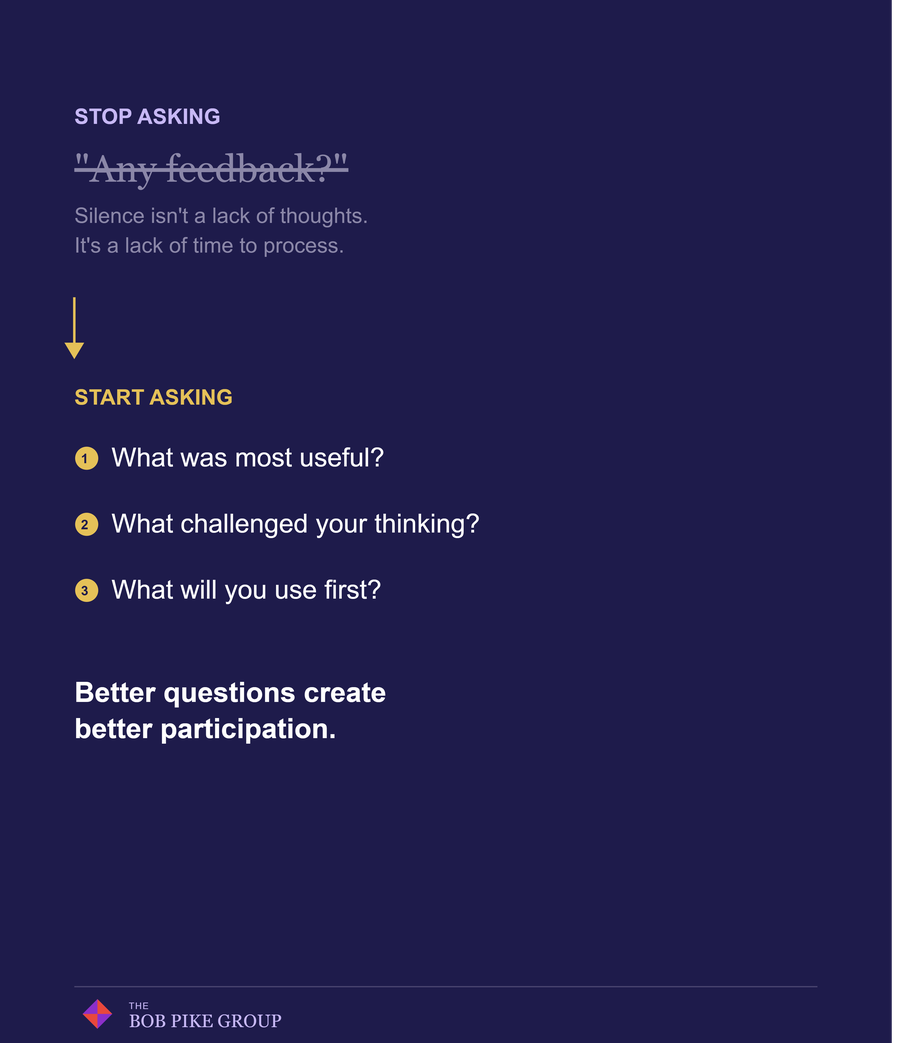
None of this requires new technology or a bigger budget. It requires treating session design as the lever, instead of asking learners to out-focus their own phones.
The Real Question
The old framing was "how do I hold their attention for the whole session?" That's the wrong question. It assumes attention is a battery you're slowly draining and trying to protect. The better question is "how do I keep re-earning it in small, deliberate moments?" That's a design problem you can solve, session after session.
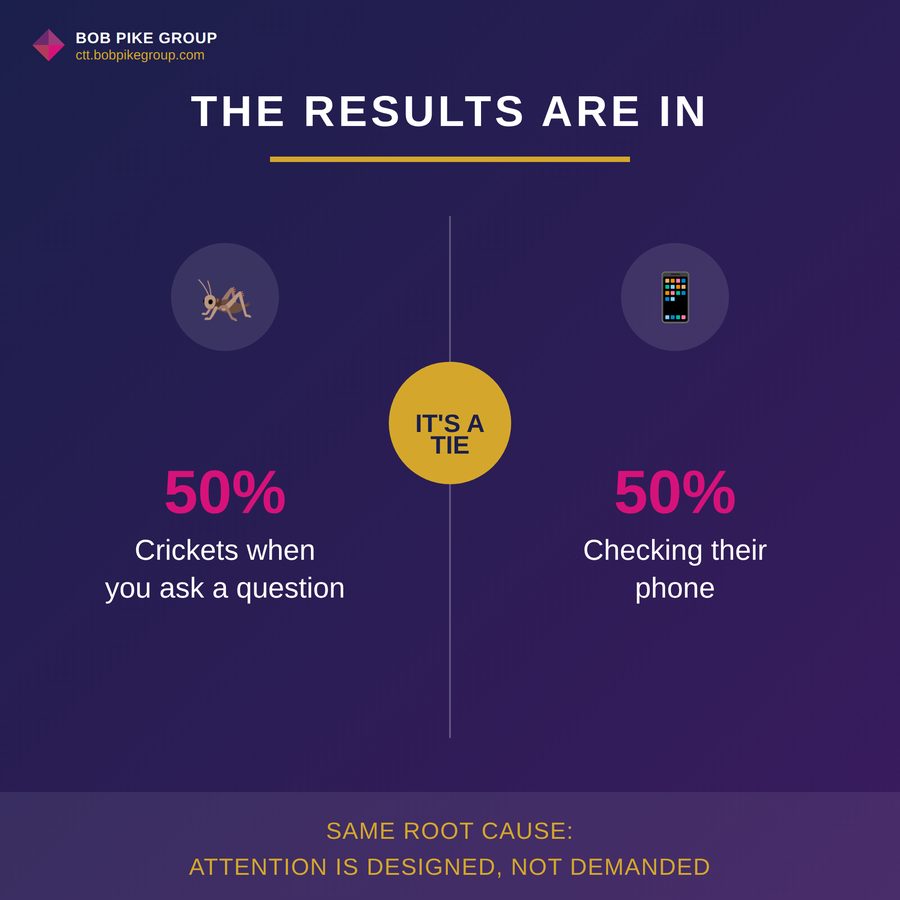
We put this exact tension to our community, asking what drains trainers more: silence when they ask for feedback, or half the room checking their phones. The vote came back split right down the middle — which is the clearest evidence yet that these aren't two separate problems.
This is exactly the kind of thing we spend real time on in our instructor-led, participant-centered workshops — including our Train-the-Trainer programs — less about trying harder to hold a room, and more about redesigning the room so it holds itself. See what's coming up on our Workshop Calendar.
What's one moment in your last session where you could feel you'd lost the room — and what got it back? Tell us in the comments or bring it to the conversation on LinkedIn.
Quick answers to a few common questions on this topic:
FAQ: Attention Spans and Training Design
Are attention spans actually shrinking? Not really — people can absolutely focus for more than a few minutes. What's changed is how much is competing for that attention at any given moment, from notifications to second screens. The practical challenge for trainers is competition for attention, not a shorter attention span.
Why doesn't "just make it shorter" fix attention problems in training? Because shortening content treats the symptom, not the cause. If the real issue is a high-distraction environment, cutting content down doesn't remove the competition for attention — it just removes content. As Becky puts it, short is a format, not a strategy: the content should determine the length, not an arbitrary rule about attention spans.
What is chunking, and why does it matter for learner attention? Chunking means breaking training content into logical pieces that build on one another, each sized to a single clear learning outcome — not making everything as short as possible. Becky's rule of thumb: chunk, don't chop.
How often should a training session change pace or activity? Bob Pike's 90/20/8 rule is a good anchor: teach for up to 90 minutes without a full break, chunk content into 20-minute sections, and build in some form of interaction at least every 8 minutes. Watch the room, not just the clock — a dense section may need a shift sooner.
What's the difference between chunking and chopping content? Chopping is cutting content into arbitrary lengths — three-minute clips regardless of what each piece contains. Chunking is breaking content into logical pieces that build on one another, each sized to a single clear learning outcome. Becky's compliance training redesign is a good example: eight 15-minute modules with a defined outcome each, instead of one long marathon or dozens of disconnected clips.
What should trainers do when they notice phones or side conversations during a session? Treat it as data about the session's design rather than a discipline problem. If attention is leaving the room, it's a signal something in the pacing, chunking, or engagement structure needs to shift — not evidence the audience is disrespectful or unmotivated.
This post is based on "When Shorter Microlearning Isn't Smarter," a recent episode of the Creative Training Techniques® podcast from The Bob Pike Group. Subscribe or follow to hear more conversations like this one.
The Bob Pike Group has been equipping trainers with practical, proven tools since 1979. Whether you're looking to improve your session design, rethink your approach to microlearning, or bring our methodology to your entire team, we're here to help. Reach out to training@bobpikegroup.com or 952-829-1954.